The Full Guide
On the Desk
Injury Prevention, Posture, School, Desk Activities, Gaming
Intro
There are many activities that involve desks, whether it's drawing to studying for a big test. There are many important aspects to consider when doing work on a desk. On many occasions, people lose their posture and have a tense body when there are prolonged times of being on the desk. If you want to learn how to prevent injury and prevent having a tense body on the desk, this is perfect for you. If I have to be honest, almost nobody would follow a perfect angle degree ergonomically, but getting it to the good range usually is more than enough.
-----------------------------------------------------------------------------
I can admit...often times in school, my posture can become very uncomfortable as the day goes on. Specific parts of our body are put under tension and weakness, as shown in the image to the right. Not only body tension, but also it can affect the body internally. Think about it to the whole body like this:
Head - Sitting can cause blood clots and headaches.
Back - Sitting for long periods of time can put high pressure on your spine, causing injury from sudden movements.
Legs - The body contains fluid on the inside, which can "collect" over time. Moving the body is a great way to make yourself feel better.
Feet - When your feet get numb, it's usually because of poor circulation of fluids. It also puts pressure on the nerves.
Arms - Tension in the arms and wrists become more prominent.
Specifically when doing activities like journaling, gaming, schoolwork, other desk activities, the most movement there may be is within the hands through the elbow. The hand has muscles, tissues, and joints obviously, so treat them like as if you are doing a sport or playing an instrument. In poor posture, every click, typing, and writing for thousands of minutes can contribute to significant negative effects. This small movement can make micro tears in tendons and internal irritation of surrounding internal areas.
According to Physical Therapy & Sports Medicine Centers,"Nerves can also become compressed or irritated as they pass through “tunnels” of bone and ligament, especially when joints are held in awkward, non-neutral positions for extended periods. This constant, low-level stress is the primary driver behind most work-related hand, wrist, and elbow pain."
A lot of these injuries are caused by repetitiveness, but how can we prevent them. This is the part everybody wants to know. One part is ergonomics. What is ergonomics? It is to be comfortable and efficient while you work/do activities. While doing your activity, try keeping your forearm completely straight. "Imagine a straight line running from your forearm, through your wrist, and into your hand" (Physical Therapy & Sports Medicine Centers). It's best not to continually move your wrists side to side or up and down. Try not to grip too much on your pencil, gaming controller, or your mouse. It often provides unnecessary tension. A way to provide healthy movement is by relaxing the wrists and doing movement that way. The wrists should be really heavy. Imagine someone lifting your hand; it should be feeling really dense, letting go of the "hold". Sometimes, gripping a pencil can be hard. Using a pen or using a pencil with less pressure can work. Sharpening the pencil can also be better too.
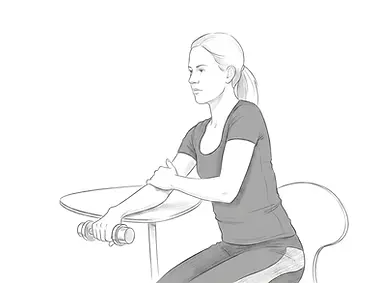
Another prevention way is eccentric strengthening. This is about strengthening the muscles while it's in length under tension. (extending, not contracting) View examples below. Just make sure to not tense your wrist too much as you are doing this. It should be more of a release.
Overall, these are some great ways to prevent these kinds of injury, especially if your main job is to be on a desk! Find the exercises that make you feel the most comfortable. You should stop doing these and reach out to a professional if you have pain before doing any of these.


Make sure to take frequent breaks when being on the desk!
What is trapezius? It is a diamond shaped muscle that is on your back.
Sciatica? Nerve pain that starts in the lower back and comes down to your leg.
Discs? This is a rubbery substance that is in between each of the vertebrae, which absorbs shock and protects each vertebrae together. In this example, they start to lose stability.
______________________________________________
When you sit in the position above, your posture sits similarly as is shown in the picture. It gets harder to move the posture back to the healthy range. Your body structure starts changing, and later the other bones and joints act upon it. You may be wondering "Why is posture even bad for you and What is posture?" Really, posture is a huge part of desk mobility, and with the right approach, could actually be improved.
Generally speaking, posture is the curve of your spine and how the muscles act upon it while doing movement or sitting/standing. Good posture is when your spine and muscles are working together to stay correctly aligned. If you had no muscles, there wouldn't be enough support and movement (when your body correcting your sitting posture by moving your back into place) for posture to work. When posture works at hand, lots of parts in your muscles may be getting stretched, while others more tensed. In this case, you actually want to be balanced throughout the body for posture to be effective enough. For example, you may be carrying a cross body purse or a big backpack, which can cause your body to "slump" into a position, making yourself feel more comfortable. Similarly, this can act when you are gaming, drawing, or even doing your homework/being at school.
I'm definitely not trying to make you scared. Posture is something that is okay at times to give yourself a "break", but actually, those who have been practicing good posture while sitting more often are more likely to stick with the good posture longer. A test you can do is trying to sit on a chair and go into a good posture position. If you are unable to do so/can barely hold it, then you should work on getting your posture more balanced. A picture below is a great reference for good posture.
What so many people miss is that with the people who have bad posture for a prolonged period of time, the most natural way to change posture is body awareness. Being aware of when that one part of your body starts to slump back down. When you are so concentrated in a desk activity whether it's gaming, drawing, or writing an essay, you forget what position your body is in. There becomes less engagement between the brain to spinal cord (alpha gamma reflex loop - the body's automatic posture control). Body awareness can be more difficult, but try to engage from mind to muscle as if you're doing a workout. Try doing yoga or go out for a walk. Try doing some active stretching as well to strengthen the back (using your muscles more than having passive assistance). These small activities can force your brain to feel to connections better, and once they click, you'll know what I mean :)
If this may be tricky, sometimes it can be the way that the desk is specifically set up. As humans, we have different torso lengths, so it's really important to measure and make sure that the desk is nicely set up ergonomically for you to be in. You can always use a thick pillow/something sturdy + comfortable to use on top of a chair so that the body lines up. Also ensure that your low back is supported by the chair. Do whatever feels best for you. Maybe you need to put your chair back a bit more or maybe you need to move your monitor down. See the picture below from the Cleveland Clinic for an example.


"We’re all guilty of poor posture sometimes – fatigued at the end of a long day, a tough workout at the gym, poorly designed workspaces, or just a bad night of sleep. When we are not standing or sitting straight and engaging our muscles, when our shoulders are rounded, or our neck is not held high, we are showing signs of bad posture" (Brown University Health).

81% of people who are musicians, do physical activity, are on the desk have poor posture.